Autonomous Vehicles

Understanding Adversarial Transferability in Vision-Language Models for Autonomous Driving: A Cross-Architecture Analysis

Vision-language models (VLMs) are increasingly used in autonomous driving because they combine visual perception with language-based reasoning, supporting more interpretable …

avatar
David Fernandez

Comparative Analysis of Patch Attack on VLM-Based Autonomous Driving Architectures

Vision-language models are emerging for autonomous driving, yet their robustness to physical adversarial attacks remains unexplored. This paper presents a systematic framework for …

avatar
David Fernandez

From MIRAGE to CLEAR: Component-Level Explainable Anomaly Reasoning for Autonomous Vehicle Perception Systems

Autonomous vehicles rely on perception systems with deep neural networks for traffic sign recognition (TSR), automated lane centering (ALC), and object detection (OD). While these …

avatar
David Fernandez

WIP: From Detection to Explanation: Using LLMs for Adversarial Scenario Analysis in Vehicles

We propose a framework that leverages Large Language Models (LLMs) for adversarial scenario analysis in Autonomous Vehicles (AVs), generating interpretable explanations for …

avatar
David Fernandez
Avoiding the Crash: A Vision-Language Model Evaluation of Critical Traffic Scenarios featured image

Avoiding the Crash: A Vision-Language Model Evaluation of Critical Traffic Scenarios

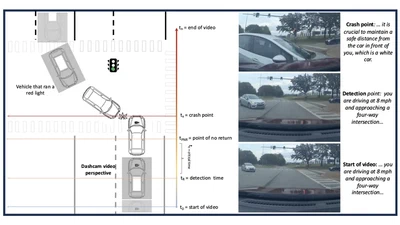
Autonomous Vehicles (AVs) have transformed transportation by reducing human error and enhancing traffic efficiency, driven by deep neural network (DNN) models that power image …

avatar
David Fernandez

David vs. Goliath: A Comparative Study of Different-Sized LLMs for Code Generation in the Domain of Automotive Scenario Generation

Scenario simulation is central to testing autonomous driving systems. Scenic, a domain-specific language (DSL) for CARLA, enables precise and reproducible scenarios, but …

philipp-bauerfeind